A few weeks ago, I learned about the passing of a good friend, Steve Uhrig. A few years ago, I was involved in projects relating to IT security, surveillance, tracking and communications, and in this line of work I met Steve. When I joined a TSCM mailing list, actually, the TSCM mailing list, one of the members that caught my attention was him – always outspoken, honest and technically sound. He would not take crap from anybody, and provided lengthy explanations or rebuttals in his posts. He was always there to lend a hand.
Steve ran SWS Security, and specialized in everything related to surveillance and communications, working with many government agencies over the years, and even becoming the technical advisor in the movie ‘Enemy of the State‘, where he also got a small part as the guy selling electronics in a shop. You can read more about him and his activities in his own website, still maintained by his friend M.L. Shannon. He was also involved in the amateur radio community, his callsign WA3SWS now silent, also actively participating in emergency communications support.
Whenever I got stuck in a particular subject, Steve would always gladly help, spending hours answering to emails about technical subjects in great depth, be it grounding systems for lightning protection to high-performance surveillance camera systems. I will miss him a lot, and only wish I could have had more time to get to know him better. This time of the year is when one tends to remember parted friends and family, so this is my little tribute to his memory.
Archiv für Dezember 25, 2006
How not to install a WiFi antenna
Leaving aside regulatory issues that may turn this particular setup into an illegal operation, I will better not describe the quality of the installation to be polite. Check out this picture:
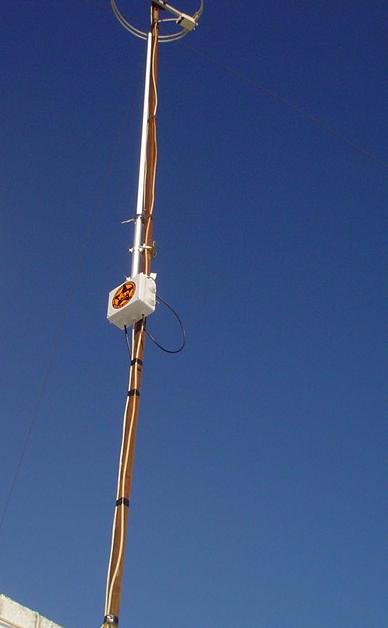
Spotted the problem yet? Radio antennas are affected by any element that is present around them, even non-metallic elements, such as the ground. In this particular case, kanijo, a Fonero, has attempted to provide more “range” to his FON hotspot, which is in itself commendable, however, the means may not result in the desired end.
You can see that the vertical omni antenna, a carefully tuned radiating element, has been strapped to a metallic pole, which also runs a coaxial cable into a TV antenna right on top. The router is inside a sealed plastic box, with power and Ethernet going into it from below. There is no way that this antenna is radiating correctly, as the pole that supports it is probably grounded (if it has been installed according to regulations), and even if it is not, it is inducing an imbalance into the tuned element, causing a large amount of RF to be attenuated. The user reports good results with it, which are most likely due to good luck.
The second problem with this type of setup is that vertical antennas don’t emit downwards, and thus will provide very limited coverage to users below the antenna. There is some downwards bleed of course, but it will only reach lower users that are some distance away from the antenna.
Recommendations for these sort of setups: install the antenna right at the top of its own pole, and ground the pole. If you have no choice but to use an existing pole, get a T arm fitting and mount the antenna at least 1 meter (3 feet) away from the pole. A perfect example of such as setup, in this case with two supports as the antenna is rather large and care for wind load is needed, is this (credit to Roger Halstead):

Check out Roger’s page, it is a very good read if you are interested in radio installations.